Death tarot card meaning
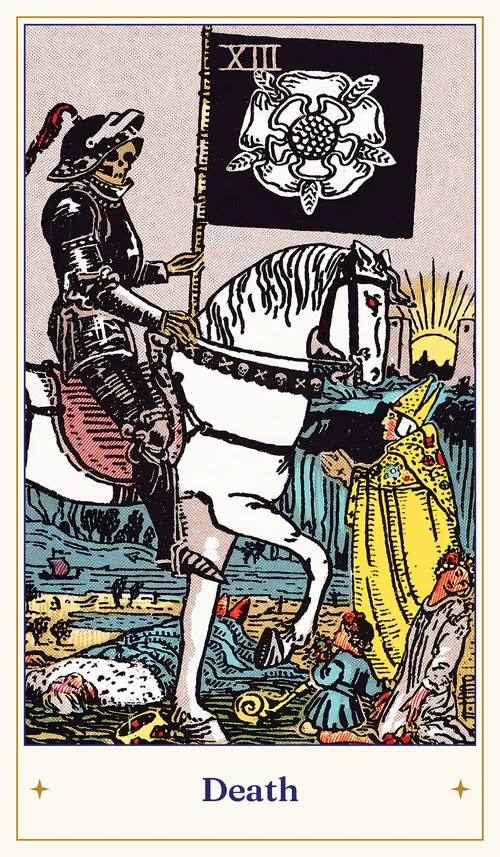
The Death card is about endings and transformation, not physical death. Upright, it stands for a chapter closing, letting go and making way for something new. Reversed, it can point to resisting change, fearing endings or holding on to what is already over. It is card 13 of the Major Arcana.
What does Death mean for you?
Add your date of birth to see how it sits with your Life Path. Free, nothing is saved.
Death at a glance
- Upright: endings, transformation, transition, letting go, renewal
- Reversed: resistance to change, fear of endings, stagnation, holding on
- Number: 13, which reduces to 4
- Element: Water
- Yes or no: leans no for what is ending; yes for what comes next
Does the Death card mean someone will die?
Almost never. This is the most important thing to know about the card. In tarot, Death is symbolic. It represents the end of a phase, a relationship, a job, a belief or a way of living, so that something new can begin. Readers very rarely interpret it literally, and you should not read it as a prediction of physical death.
What the card shows
A skeleton in black armour rides a white horse, carrying a black flag marked with a white rose. Before the horse, people of different stations, such as a king, a bishop, a woman and a child, react in various ways. In the background, a sun rises between two towers, and a boat travels down a river.
The skeleton shows what remains when everything temporary is stripped away. The white rose on the flag stands for purity and renewal. The figures of different ranks show that change comes to everyone. Most importantly, the rising sun in the background reminds us that every ending is followed by a new day.
Upright meaning
Upright, Death says that something is coming to an end. It may be a situation you have outgrown, a relationship that has run its course, a job, a habit or an old version of yourself. The card asks you to let it go.
This can be difficult, but Death is fundamentally a card of renewal. By releasing what is finished, you make room for growth. Transitions are rarely comfortable, yet they are necessary, and Death suggests the change is already under way.
The card encourages acceptance. Fighting a natural ending often prolongs the pain, while accepting it allows you to move forward.
Reversed meaning
Reversed, Death may suggest that you are resisting a change that needs to happen. You might be holding on to a situation, person or habit out of fear, even though it no longer serves you.
It can also point to stagnation: knowing something must end but feeling unable to take the step. The reversed card gently encourages you to release your grip, as the change will likely come either way.
Death in love
Upright: For singles, Death may suggest letting go of past relationships or old patterns before new love can arrive. For couples, it can mean the end of one phase and the start of another, such as a deeper level of commitment, or, in some cases, the end of a relationship that has naturally completed.
Reversed: It may suggest holding on to a relationship that is over, or fearing the changes needed to make a relationship work.
As feelings: Upright, someone may be going through a big change in how they feel.
Death in career and money
Upright: At work, Death can point to the end of a job, a project or a career path, often making way for something better suited to you. It favours reinvention.
Reversed: It may suggest staying in a role you have outgrown because change feels too risky.
Money: Upright, it can mean the end of one financial situation and the start of another, such as clearing a debt or changing how you earn. Reversed, it warns against clinging to habits that are not working.
Death as yes or no
Death leans no for questions about keeping things the same, and yes for questions about change, transformation and moving on.
Death and numerology
Death is numbered 13, which reduces to 4 (1 + 3 = 4). In numerology, 13 is also a karmic debt number, linked with lessons around hard work and transformation. Its root, 4, is the number of foundations. Together they suggest that endings clear the way for new structures. The tool on this page shows how this card relates to your Life Path.
Death for health and wellbeing
In health questions, Death is read as the end of an old habit or lifestyle and the start of a healthier one. It is not a prediction of illness or death. Tarot is a reflective tool, not medical advice.
Death in a reading
- Past: an ending that transformed you.
- Present: something is completing; let it go.
- Future: a significant transition is ahead.
- Advice: accept the ending and make room for renewal.
Common Death combinations
- Death and the Tower: sudden, major change.
- Death and the Star: renewal and hope after an ending.
- Death and the Eight of Cups: walking away from something that no longer fulfils you.
- Death and the Ace of any suit: an ending followed by a fresh start.
Questions to ask when Death appears
- What in my life is already ending, even if I have not accepted it yet?
- What am I holding on to out of fear rather than love?
- What could grow in the space this ending leaves?
- How can I honour what is finishing while letting it go?
Frequently asked questions
Does the Death card mean death?
Almost never. It is a symbolic card of endings and transformation, not physical death.
Is the Death card bad?
Not necessarily. It can be difficult, but it is fundamentally a card of renewal and new beginnings.
What does the Death card mean in love?
It points to the end of one phase of love and the start of another, or to letting go of past relationships.
What does Death reversed mean?
It can mean resisting change, fearing endings or holding on to something that is already over.
Go further
Related
Written by the NumberTeller editorial team. Updated 13 November 2026.
Tarot readings are offered for reflection and guidance. They do not predict events, and no specific outcome is promised.